100+ questions. Randomised. Tips based on your performance.
Click a period to expand.
Patterns across case studies for compare & contrast questions.
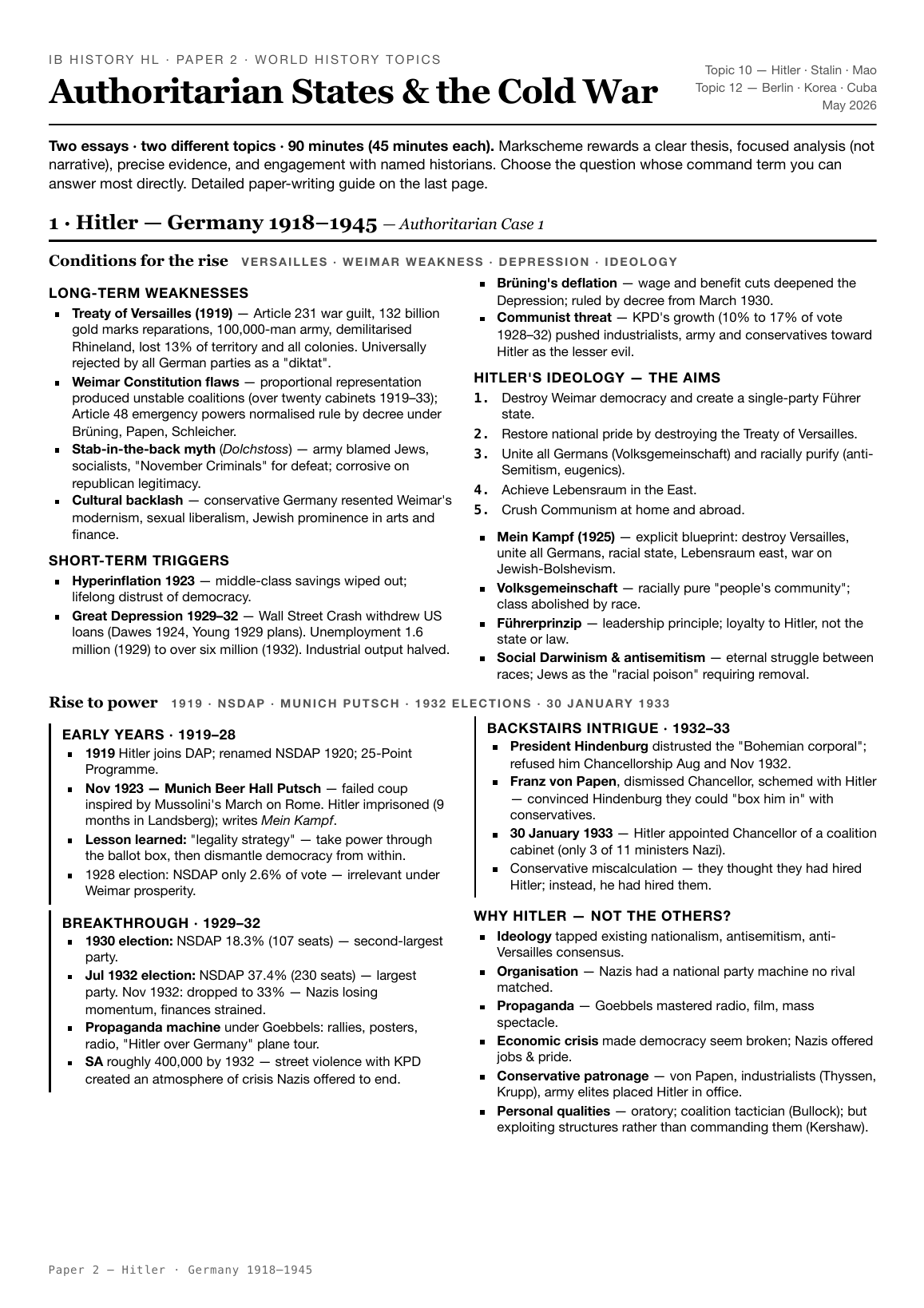
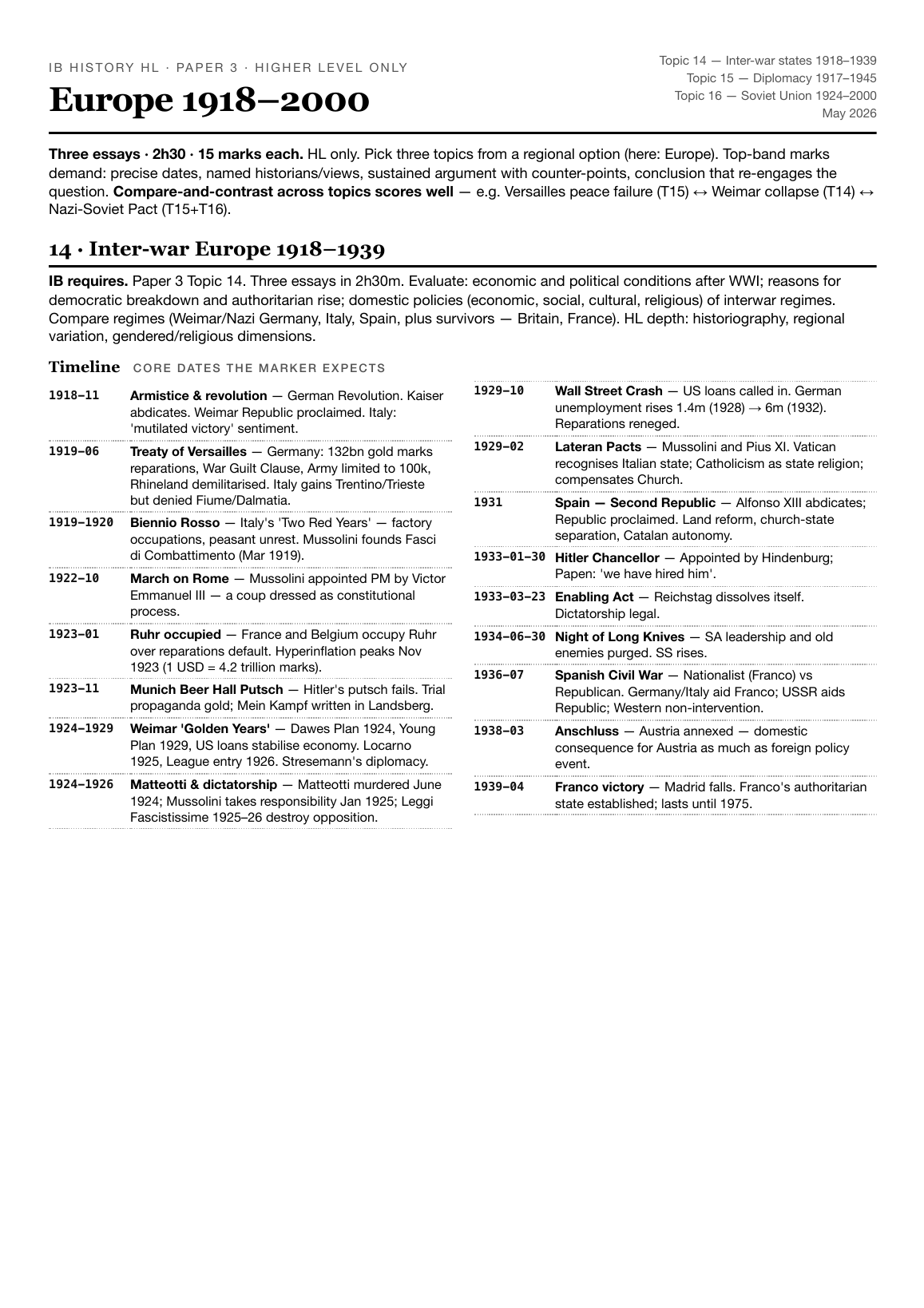
Underlying grievance → weak/failing system → strong leader/military offering solution. Japan: discrimination + weak civilian government + military expansionism. Italy: "mutilated victory" + divided state + Mussolini's promises. Germany: Versailles resentment + Weimar collapse + Hitler's national revival.
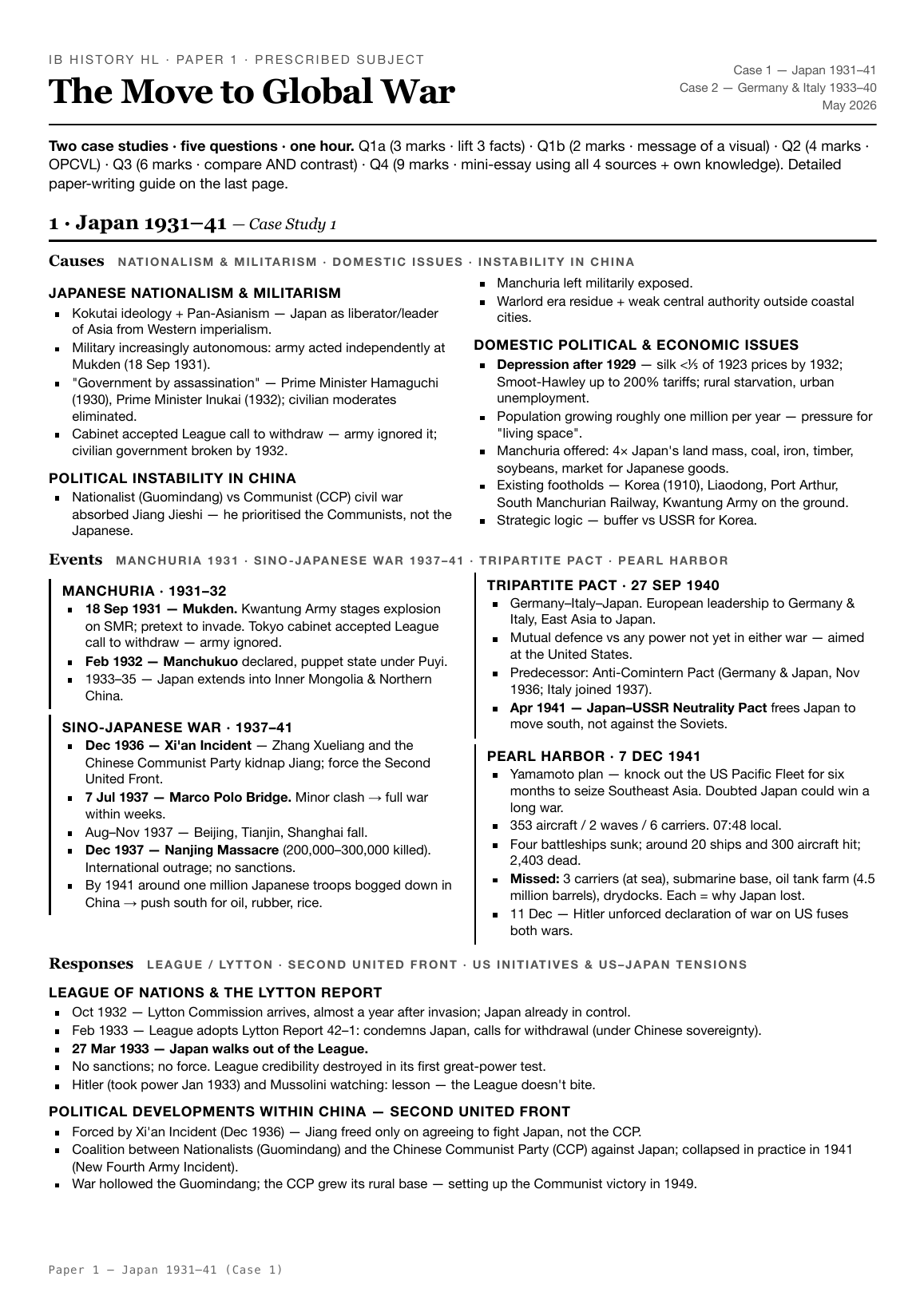
Japan: Mukden Incident (Sept 1931) — staged railway explosion. Italy: Abyssinia border clash — exploited as pretext. Germany: Gleiwitz (Aug 1939) — SS dressed as Polish soldiers, dead prisoners in Polish uniforms. Same playbook.
Japan: Military dragged government into war (Kwantung Army acting without approval). Germany: Hitler dragged reluctant generals into war (Hossbach Memorandum pushback). Same outcome, opposite dynamics.
Japan: Shidehara diplomacy. Germany: Stresemann stabilisation. Both relied on US support. Both destroyed by the Depression. Both replaced by aggressive nationalism.
Manchuria: Lytton Commission too slow, no sanctions. Abyssinia: Sanctions deliberately weak — US increased exports, Suez Canal never closed. Rhineland: No response at all. Each unpunished act emboldened the next.
Japan: Military ambition + economic necessity, enabled by weak civilian government. Italy: Post-war disillusionment + fragile state → Mussolini promises unity + imperial glory. Germany: Versailles resentment + economic collapse → Hitler's promises of national revival.
Cross-party support; Versailles seen as too harsh; economic crisis; military exhaustion from WWI; anti-war public opinion (Spanish Civil War bombing); British overstretch (India, Palestine); Japan threatening Asian colonies; right-wing wanted Germany as USSR buffer; Chamberlain thought he could deal directly with Hitler.
Paper 1 structure, markbands, and how to hit top marks.
Q.a [3]: "What, according to Source X..." — pull 3 points from source. 1 mark each.
Q.b [2]: "What does Source X suggest..." — inference (usually cartoon). 2 points.
Q.c [4]: OPVCL — value AND limitations using origin, purpose, content.
Q.d [6]: Compare & contrast — BOTH similarities AND differences.
Q.e [9]: Mini essay — sources AND own knowledge synthesised.
Origin — who, when, where, what type. Purpose — why created, audience. Value — why useful for historians. Content — what it says/shows. Limitation — bias, missing context, narrow perspective.
Don't list mechanically. Weave: "Because this was written by a Japanese businessman with interests in Manchuria (O) to critique the Lytton Report (P), it reveals how Japan justified its actions, but is limited by the author's financial stake in the region."
Don't do "all Source A then all Source B." Integrate with linking phrases. Must have BOTH similarities AND differences. Top band (5–6) = clear, valid points of comparison AND contrast.
1–3 Descriptive, vague, no source refs.
4–6 Some analysis + sources, but general evidence, little synthesis.
7–9 Focused, sources used effectively as evidence, accurate own knowledge, effective synthesis.
Key lever: "Countries were aggressive" → "Japan's Kwantung Army staged the Mukden Incident in September 1931." That's the difference between 5 and 8.